![[current-page:title]](svg/facebook.svg)
![[current-page:title]](svg/linkedin.svg)
![[current-page:title]](svg/email.svg)
“Doctors tell people to eat right, exercise, and quit smoking all the time. But they can’t force them to do it.”
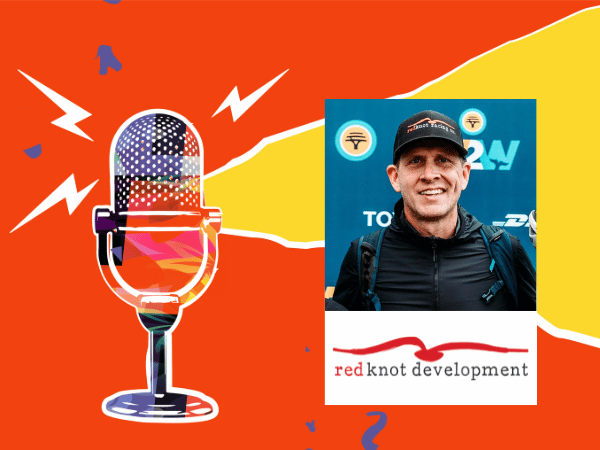
Brett Harrison isn’t a physician, but his analogy fits. As the founder of Red Knot Development, he sees his role as a partner (not a prescriber) of change.
“We only work where we’re invited, and we don’t offer pre-planned solutions. Rather, we ask what about their goals, assess assets, and help them design projects to solve problems in a way that, five years down the road, someone local has the tools to overcome the next obstacle.”
He and his wife moved to Tanzania in 2009. His work focuses on agricultural education, rural livelihoods, and fostering youth development through local cycling and running clubs.
Johanna, His Favorite Success Story
Brett has an MA in soil science, so agriculture was a natural place to begin community development work. But knowing something, and persuading others to try, are worlds apart.
“Doing things differently in rural communities can often lead to being pushed out. You do the same thing every year, and if you do something different and it goes wrong, you’re probably the one to blame.”
Most farmers weren’t interested in changing their methods. At least, until he formed a relationship with a man named Johanna.
“He was a bit different before I came along, and already an innovator in his community, so I don’t take credit for this. But he was the first person who ever gave me a plot of land to experiment with, and in year one, we produced maize that was better than anything on the rest of the farm. By year two or three, all of his maize was doing great.”
Johanna may have been willing to go against the grain, but the risk he took on Brett was still calculated (and pretty funny in hindsight).
“Years later, Johanna told me about this conversation he had with his wife. ‘Hey, there’s this guy. When I ask him questions, he has some ideas he thinks may help, but they sound crazy. Should we try?’ And she goes, ‘Don’t give him any of our good land. Give him the worst we have that won’t produce anything.’”
That scrappy little plot – originally the farm’s worst – ended up proving two things: the soil had potential, but so did the partnership.
Measuring “Successful” Community Development
For his first twelve years in Tanzania, Brett evaluated his efforts with three basic questions:
“Are people implementing what I taught, are their neighbors implementing it without my intervention, and are they meeting the goals they said they had?”
Those metrics may not satisfy a grantmaker’s dashboard, but fortunately, they don’t have to. He funds most of his work with for-profit Kilimanjaro endurance races (which he also manages), or donations stemming from those events.
And in lieu of external KPIs, he’s free to save time and use eyeball tests to check his progress.
“With chicken vaccination projects, I measured three things. Are people vaccinating, are their neighbors asking to vaccinate, and after three months, do they have more chickens? Pretty simple stuff.”
This doesn’t mean he’s anti-data. He has a grant for his children’s running club to track, and over time, has introduced more structure to his monitoring. But he’s skeptical of outside agendas that sometimes overshadow local priorities.
“In Sakumaland, anything to do with chickens is seen as women’s work, while men generally deal with the cows. But every grant I know of wants 50/50 male-female participation, so that’s strange within the local context. Promoting gender equality is beneficial, but it’s certainly not as important as making sure people have more food at the end of the year. At least, not to me.”
He also shared that, sometimes, monitoring and evaluation can focus on the wrong things altogether.
“There was this project where they gave locals per diems to come to a class and learn an agricultural technique. I’m sure it was reported to donors as a success because their entire metric was how many farmers they trained. But when we started looking these people up, it turns out none of them were practicing the technique themselves. The development organization wasn’t measuring implementation, and the entire project wound up a massive failure.”
Revisiting Johanna’s Story
During our conversation, Brett circled back and emphasized this point more times than I can count:
“Are other farmers, that I’ve not taught, implementing this?”
If so, the approach is appropriate, sustainable, and reproducible. If not, the program is unlikely to survive once a development organization packs up and leaves. And if that’s the case, what’s the point?
Which is why Johanna is Brett’s favorite story.
“When I left his village five years ago, he took over all my training responsibilities. That was ~500 households spread over 5-6 villages. When I visited him last April, he showed me photos of the farmers he trained to become trainers themselves. It was a long-term investment. I lived and learned Swahili in his village. But it was also one of those deep, deep relationships that I think are necessary for projects to succeed.”