![[current-page:title]](svg/facebook.svg)
![[current-page:title]](svg/linkedin.svg)
![[current-page:title]](svg/email.svg)
Grant funding takes a lot of time and effort to secure, from finding opportunities that align with your nonprofit’s needs to writing standout proposals to ensuring you submit your applications on time. Once you finally receive a grant, you may think your work is done—or is it?
To make the most of your grant, you’ll need to properly record it and report its progress. Grant management, as this process is called, overlaps significantly with your nonprofit’s other accounting practices.
In this guide, we’ll discuss three aspects of grant management from an accounting perspective so you can see how they intersect and why this process is important. Here is what we’ll cover:
- Grant Funding Restrictions
- When to Record Grants
- Reporting Grant Funds
As you implement these tips, remember why grant management is important in the first place. According to Jitasa, “Grantmakers see awarding grant funding as an investment in a nonprofit whose mission and planned initiatives align with their values and vision.” Proper grant accounting demonstrates to funders that they invested wisely by selecting your organization, which can set you up for future grantseeking success.
1. Grant Funding Restrictions
One aspect of nonprofit accounting that differentiates it from business accounting is that not all of your organization’s available funds—often referred to as net assets—are completely free to use for any purpose. Instead, there are three types of nonprofit net assets, which are categorized as follows:
- Unrestricted net assets have no strings attached to them, so you can put them toward any expenditures at your organization. Fundraising event revenue, earned income like merchandise sales or membership dues, and small to mid-sized gifts with no donor designations are all unrestricted net assets.
- Permanently restricted net assets are usually endowments, which your nonprofit isn’t allowed to spend directly. Instead, you’ll invest the funds and use the interest they generate to support an ongoing program or annual initiative (such as a scholarship fund) of the donor’s choosing.
- Temporarily restricted net assets must be used for a specific program or project either until the initiative is complete or a certain amount of time has passed. Then, any leftover funds become unrestricted net assets. This category includes corporate sponsorship revenue, most major and planned gifts, and—you guessed it!—grants.
Although extra grant funds can be released from restriction, you shouldn’t count on this, as most grantmakers want to see in your proposal budget that you plan to use the whole grant for its intended purpose. Because of these requirements, Getting Attention recommends only pursuing grant opportunities that align closely with your organization’s goals.
2. When to Record Grant Funds
To ensure your financial data remains clean, develop a standardized process for entering grants into your accounting system. However, you’ll need to record funding at different times depending on the type of grant so that it’s properly organized for reporting purposes.
Here is a breakdown of three common grant types and when to record them:
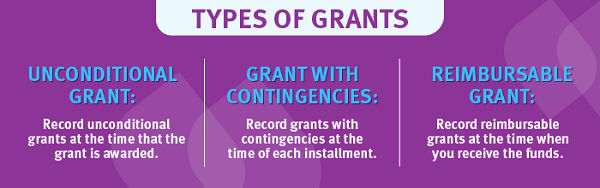
- Unconditional grants are provided upfront and can be used at your nonprofit’s discretion. Record these funds as soon as you win them, even if the check or deposit arrives later.
- Grants with contingencies require your organization to fulfill certain conditions to continue receiving the funding in installments. Record the first installment when you win the grant and subsequent payments as you receive the funds.
- Reimbursable grants are paid out after your nonprofit has spent the money for an initiative up front. Track associated expenses as you incur them so you have an itemized list to present to the funder, then record the funding when you receive it.
When applying for a grant, note its type and specific requirements so you’ll know when to record the funding if you secure it.
3. Reporting Grant Funding
Accurately reporting your grants is critical for maintaining compliance with funders’ requirements and government regulations for nonprofits. It also helps ensure transparency with your supporters about how your organization funds its mission.
In most cases, grantmakers will specify reporting requirements and schedules for your nonprofit to ensure you’ve used the funds they provided wisely and as promised. Follow these guidelines closely, as compliance is essential for your organization to potentially secure additional grants from that funder down the road. For reimbursable grants and grants with contingencies, how you report to the funder may even determine whether you receive the full amount you were promised.
To comply with government regulations, report your grants as revenue when filing your nonprofit’s annual tax return. Additionally, include a mention of grant funding in the finance section of your annual report to promote transparency with supporters.
How Grant Accounting Supports Your Mission
Effective grant accounting advances your mission by ensuring financial resources are managed responsibly and transparently. Properly tracking, recording, and reporting grant funds allows your organization to align spending with requirements, not only resulting in compliance but also building trust with funders, increasing the likelihood of securing future grants.
Accurate records provide insights into how funds are used to create impact, and these insights can be shared with stakeholders, including donors, beneficiaries, and the public, demonstrating accountability and showcasing the tangible results of your work.
Ultimately, grant accounting isn’t just about managing numbers—it’s about empowering your nonprofit to achieve lasting change.
Where to Find Grants for Your Nonprofit Organization
Finding the right grants for your nonprofit may feel overwhelming, but leveraging the right tools and resources can simplify the process. GrantStation offers one of the most comprehensive and accurate databases of funding opportunities on the market, along with a suite of resources, increasing the likelihood of achieving your funding goals.
With a subscription to GrantStation, organizations can filter grants by focus area, geographic location, and more, making it easier to identify opportunities that align with your mission.
Frequently Asked Questions
Q: How can I use accounting software to improve grant management?
Accounting software like QuickBooks or specialized nonprofit tools can simplify grant management by automating financial reports, tracking related expenses, and ensuring accurate allocation of grant money. By integrating grant tracking into your software, you can streamline reconciliation, meet accounting requirements, and improve your organization’s overall financial management.
Q: What are the risks of improper grant money allocation?
Improper allocation of grant money can lead to significant liabilities, including non-compliance with funder restrictions, penalties from the IRS, and a damaged reputation. To mitigate these risks, ensure that funds are correctly assigned to their intended purpose by implementing strict internal controls and regularly reviewing your organization’s financial position.
Q: How does grant accounting influence nonprofit decision-making?
Grant accounting provides insights into your nonprofit’s financial health by showing how funds are used in alignment with your mission. Accurate financial reports generated through careful tracking of grant funds and related expenses empower leadership to make data-driven decisions that enhance program outcomes and strategic planning.
Q: Why is financial reconciliation important for grant funds?
Reconciliation ensures that your financial records, such as bank statements and grant transactions, align with your accounting system. This process is critical for maintaining transparency with funders, verifying your nonprofit’s financial status, and meeting IRS compliance requirements. Regular reconciliation also helps identify discrepancies early, safeguarding your financial health.
While grant management also involves tracking the progress of the initiative you’re using the funding for, it’s important to understand the financial aspect of the process in order to do it properly. Use the tips above to get started, and reach out to your nonprofit’s bookkeeper or accountant if you need help or have questions along the way.
- Review your accounting data to ensure your nonprofit’s grants and other net assets are properly categorized according to their restrictions.
- Double-check what types of grants your nonprofit is currently applying for and make note of when to record those funds.
- Ensure the grant funding you’ve received is detailed accurately in the next report your organization needs to submit, whether that’s a grantmaker update, your tax return, or your annual report.