![[current-page:title]](svg/facebook.svg)
![[current-page:title]](svg/linkedin.svg)
![[current-page:title]](svg/email.svg)

Overworked and underpaid. If you have ever been employed, these three words might resonate with you, but particularly if you’ve worked in the nonprofit field, where many dedicate their careers to uplifting others at the expense of their own earning potential and may even struggle to stay afloat themselves.
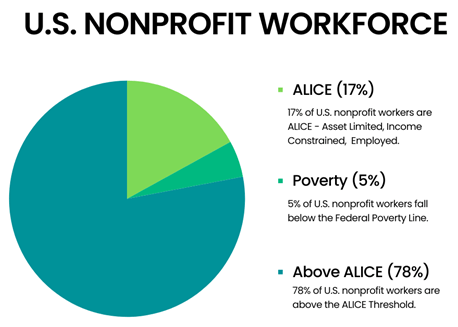
A new study by Independent Sector reveals that nearly a quarter (22%) of nonprofit employees in the U.S. are experiencing financial hardship, with five percent falling below the Federal Poverty Level and another 17% unable to afford the necessities to survive in their area, thus classifying them as Asset Limited, Income Constrained, Employed—or ALICE. Who, exactly, is most affected by these trends? What’s behind these statistics, and how are nonprofits and the foundations that support them responding?
Factors Affecting Nonprofit Wages
A deeper dive into the report reveals that some nonprofit workers have a higher likelihood of struggling to meet basic needs—including housing, childcare, food, transportation, healthcare, technology, and taxes.
Demographics and Nonprofit Wages
Demographics play a role. Wages of more than a third of Black (35%) and Hispanic (34%) nonprofit workers fell below the ALICE Threshold (those who are ALICE and those who fall below the Federal Poverty Level), as opposed to 17% of wages for white workers. Age was also a determining factor, with 27% of nonprofit workers under the age of 25 experiencing financial hardship, compared to 17% of middle-aged workers ages 45 to 64.
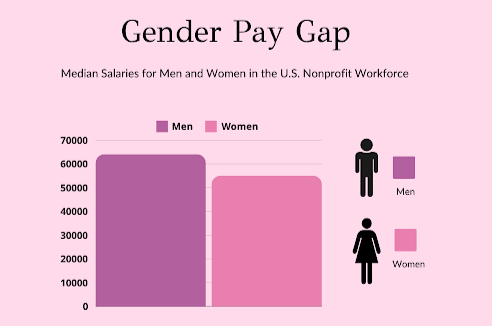
Women in the nonprofit workforce also reported lower median salaries ($55,000) than men ($64,000), although both sexes experienced the same level of financial hardship at the household level (22%).
Mission Focus and Nonprofit Wages
The sector in which one works can also have a big impact. Those working in the social assistance sector providing services to low-income individuals are among the most likely to be living in poverty themselves. Thirty-two percent of those in this subsector (and the arts/recreation subsector) reported wages below the ALICE Threshold.
Effects of Low Pay on Nonprofit Organizations
Low pay produces a snowball effect that contributes to the ongoing staff burnout reported by many nonprofit leaders. As one leader put it, “We aren’t able to pay our staff a livable wage, [which is] the exact goal we are aiming to reach for the clients we serve. With that, we see higher turnover in our case management team, in addition to each member being responsible for a larger caseload than is sustainable.”
Writers such as Vu Le at Nonprofit AF have also pointed out this irony, and the fact that it goes beyond just salaries. “Besides low wages, there are other things. Poor benefits. Six dollars per person per year for professional development. Lack of any sort of retirement benefits. Chairs that are duct-taped together. A gift card to Ross Dress for Less as a Christmas bonus.”
Humor can always help to take the edge off of a difficult situation, but undoubtedly the result can be quite serious for nonprofit leaders dealing with low morale and high staff turnover, especially when high-performing employees are forced to leave their positions in search of a livable wage. Ultimately, due to required investments in staff training and the need to offer salaries at the current market rate, losing a valued employee is likely to cost a nonprofit more than raising their salary to account for the real cost of living.
Related: Fluidity in the Nonprofit Job Market
What’s To Blame for These Overall Trends?
Global inflation is a major culprit, as wages have risen but failed to keep pace with the ever-increasing cost of living. The report notes that in 2010, a rehabilitation counselor could survive on the median hourly wage of $15.51, but by 2022, the median wage of $19.23 per hour (a 25% increase) fell far short of meeting basic needs when accounting for the rise in living costs.
But the subject of low nonprofit pay is not a new one, and many in the sector have long pointed out that foundations—and their traditionally restrictive funding practices—contribute to perpetuating poverty within the sector. Underfunding overhead expenses and resistance to awarding general operating grants are just two practices that contribute to the nonprofit starvation cycle in which organizations don’t have the resources to carry out their missions effectively, though luckily these issues are starting to be addressed.
How Funders Are Responding To Low Nonprofit Wages
The funder response to the issue of low wages in the nonprofit sector has varied somewhat by geographic location, with foundations in the U.K. addressing the issue way ahead of their U.S. counterparts.
The U.K.
Recognizing their role in low nonprofit wages, about ten years ago a group of prominent funders in the U.K. decided to form the Living Wage Funders scheme. Taking a three-pronged approach to tackling the problem in which foundations commit to paying their own workers a real living wage, funding nonprofit positions with a real living wage, and helping the organizations they fund become living wage employers, the scheme has been largely successful.
Writing for Alliance Magazine, Lianna Etkind, Partnerships and Campaigns Manager at the Living Wage Foundation, pointed out that as a result of the scheme, the rates of low pay for charity workers in the U.K. dropped by nearly a third between 2015 and 2023, down to 12%, from nearly 17%. She noted, “The imbalance of power between grantee and foundation can make it hard for a financially-stretched grantee to flag when grants are no longer covering a decent wage for all workers. Living Wage funders break this impasse, loudly and proudly declaring a commitment to reducing poverty not just as an outcome but structured into the way they operate.”
The U.S.
How is this issue being addressed in the United States? It appears that the movement for a living wage in the U.S. is catching on, though it is not exclusively driven by foundations. Living Wage for US, an affiliate of the Living Wage Foundation, was founded in 2021 with a mission to “overcome the barriers and create incentives to enable employers to pay Living Wages, affording a decent quality of life for working families.” The organization provides guidance on how to become a living wage employer and offers a two-tier certification process to become one.
At the moment, Living Wage for US primarily serves and generates income from the for-profit sector. However, as reported by Inside Philanthropy, the organization, which did receive some startup funding from Oxfam America and the Hershey Foundation, is currently in talks with other funders. Living Wage for US also hopes to serve the philanthropic and nonprofit sectors by offering a living wage certification program to foundations and giving nonprofits free access to its assessment tools.
How Nonprofits Can Fix Low Wages
Source: Some inspiration for this graphic was taken from Vu Le’s article,
"When Nonprofit Staff Are Paid So Low They Qualify for Their Org’s Services."
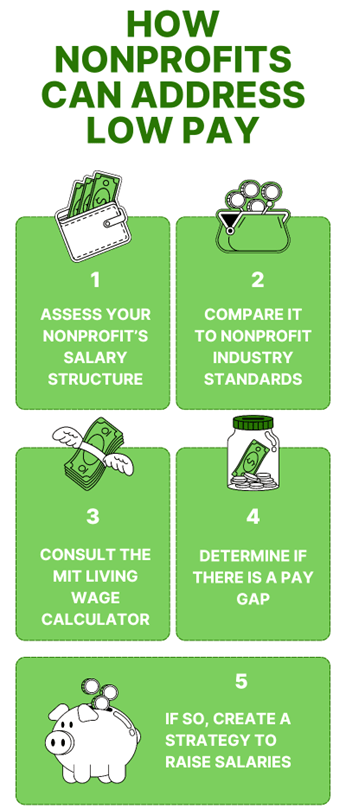
Nonprofit leaders looking to ensure that they are paying a living wage should first look at their organization’s existing salary structure. Do any salaries stand out as particularly low? Are there wide variations in salaries for workers in similar roles?
To gain a better understanding of whether each employee is being paid fairly, consult the recent salary and benefits reports published by the NonProfit Times, the Grant Professionals Association, CharityVillage (Canada), or Keela (Canada and the U.S.). An essential first step to paying a living wage is ensuring that current wages are in line with industry standards, and that includes reviewing salaries for each specific role within your organization.
For location-specific information, MIT’s Living Wage Calculator provides data on the living wage by state, metropolitan area, and county for a number of family types. The National Council of Nonprofits also compiles a number of state-level reports focused on nonprofit-related topics, including salary information.
If your research reveals a gap between employee wages and the cost of living for their role or your area, be sure to establish a strategy to address this.
The Living Wage for US guidance document provides a detailed plan on how to start the process of providing a U.S. living wage, including information on what types of benefits can and cannot be used to achieve this. In short, those that reduce the cost of living or provide additional income to workers (such as health insurance, retirement benefits, flexible spending accounts, etc.) may contribute to a living wage, whereas other perks (such as vacation days and gym memberships) do not. Thus, it is important that nonprofits looking to become living wage employers focus on meeting the concrete financial needs of employees, ideally in the form of higher salaries.
If your organization needs a deeper pool of funds to achieve this, consider researching funders that award general operating grants, as this will give you more flexibility when determining where to allocate funding.
Establishing a robust fundraising program can be another pathway to raising salaries. This might involve bolstering your Giving Tuesday outreach, organizing an in-person gala or auction, or soliciting salary-specific donations from dedicated supporters to help align your organization’s wages with its stated values and mission. Whatever the path, ensuring that your organization is paying a real living wage will contribute significantly to both staff and organizational well-being.