![[current-page:title]](svg/facebook.svg)
![[current-page:title]](svg/linkedin.svg)
![[current-page:title]](svg/email.svg)
.png "Where Mission Meets Resilience: Rethinking Sustainability in the Social Impact Sector")
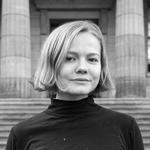
Across the nonprofit and development sectors, long-standing assumptions about funding, growth, and sustainability are being fundamentally reexamined. For Lucy Jodlowska, the future of social impact work depends on one essential principle: resilience—financial, operational, and mission-driven.
As Senior Director of U.S. Programs at Winrock International, Lucy has spent her career navigating the intersection of agriculture, climate resilience, and community development, both in the United States and globally. In a sector shaped by uncertainty, shifting funding landscapes, and increasing climate pressure, her work reflects a steady commitment to building systems that can adapt and endure.
A Career Shaped by Systems and Sustainability
Before joining Winrock International, Lucy built a career at the intersection of public service, business, and international development. She began as a consumer fraud investigator in Chicago, working with government watchdogs to address scams that disproportionately affected immigrant and low-income communities—an experience that sharpened her focus on the root causes of poverty and vulnerability.
Lucy later earned a Master of Public Administration and an MBA in California, where her exposure to social enterprise and business-driven approaches to development reshaped her career path. She went on to work across Africa, Central America, and Latin America, helping mission-driven organizations design sustainable revenue models—experience that ultimately led her to Winrock in 2016 and continues to inform her leadership today.
An Organization in Transition
Historically, Winrock International was best known as a large-scale international development organization, implementing multimillion-dollar agriculture, climate, and labor projects primarily funded by the U.S. government. Much of that work focused on emerging economies, with projects spanning dozens of countries and addressing everything from forced labor to climate mitigation.
But the organization was never singular in its approach. Even before recent disruptions, Winrock maintained a vibrant and diversified portfolio beyond government contracts—working with philanthropy, private companies, and communities on economic development, ethical supply chains, and climate-smart agriculture.
Over the past year, however, that diversification has become central rather than complementary.
“Like many organizations in this space, we experienced the termination of the majority of our international U.S. government-funded work,” Lucy says. “We handled the closures as thoughtfully as possible, but it was still painful.”
At the same time, the shift accelerated changes that were already underway. Today, Winrock is intentionally repositioning itself around an impact-first model, prioritizing partnerships with aligned funders and clients—including philanthropy, multilateral institutions such as the World Bank and the Green Climate Fund, municipalities, and private-sector companies.
“The goal is not to have all our eggs in one basket,” Lucy says. “Different partners bring different strengths, expectations, and opportunities. Our work now starts with shared impact goals, and then we build the operational model around that alignment.”
The Challenge of Doing Good Work Well
One of the most persistent challenges Lucy identifies is familiar to many nonprofit and social impact leaders: funding structures that undervalue the infrastructure required to deliver impact.
“There’s a disconnect,” Lucy says. “Funders want results but often place strict limits on what they consider acceptable costs [such as] communications, accounting, compliance, operational support. Those things get labeled as ‘overhead,’ even though they’re essential.”
Navigating the varying rules, definitions, and restrictions of different funders consumes time and energy that could otherwise be spent on strategy and implementation. While the issue is longstanding, Lucy notes that progress has been slow across the sector.
Why Winrock Is Different
What sets Winrock apart, Lucy says, is its ability to work across vastly different geographies and contexts—and to learn from those comparisons in real time.
“We might be implementing similar agricultural or climate adaptation practices in rural Arkansas and in West Africa,” Lucy says. “That allows us to see what truly scales, what’s context-specific, and how solutions need to be adapted.”
This cross-context approach also challenges assumptions about where poverty exists. “In the U.S., especially in parts of the South, there are communities facing levels of poverty and lack of access that mirror what we see in emerging economies,” Lucy says. “Because we work in both spaces, we’re able to intervene in very difficult contexts and apply lessons across borders.”
Food Systems at the Center
Looking ahead, Lucy sees food systems and agricultural transitions as a major focus for Winrock’s work over the next five years.
That includes supporting farmers—particularly small and mid-sized operations—who are increasingly vulnerable to climate shocks, market consolidation, and financial instability. Winrock’s approach integrates regenerative and climate-adaptive practices with a clear-eyed focus on economic viability.
“These challenges aren’t unique to the U.S.,” Lucy says. “Food security and climate preparedness are global issues, and we’re addressing them both domestically and internationally.”
Where Mission Meets Profit in the Classroom
Beyond her leadership role at Winrock, Lucy carries these ideas into the classroom, where she helps emerging practitioners rethink what it means to build sustainable, mission-driven organizations. Lucy’s work at Winrock directly informs her role as an adjunct professor at Johns Hopkins University, where she teaches Mission Meets Profit: How to Build a Social Enterprise through the university’s nonprofit management program. The course brings together students from diverse backgrounds, including nonprofit leadership, business, international development, museum studies, and NGOs. Many of her students, she notes, arrive deeply committed to mission—but constrained by a scarcity mindset shaped by traditional nonprofit funding models.
“Their first instinct is often ‘How do I find more grants or donors?’” Lucy says. “I try to help them step back and ask a different question. What value are you creating, and who actually needs it?”
The class emphasizes the same principles guiding Winrock’s evolution: clarity of purpose, diversified revenue streams, and financial viability alongside social impact. Students examine real-world operating models, staffing needs, cash flow, and the true cost of delivering impact.
“Mission-led work still has to function as a business,” Lucy says. “If you can’t operationalize an idea, if you don’t understand the mechanics, it won’t survive, no matter how important the mission is.”
Her experience managing a complex mix of funding sources at Winrock—from philanthropy to fee-for-service contracts—provides practical insight into the trade-offs of each model. In turn, the classroom becomes a testing ground for ideas that reinforce her belief in social enterprise as a powerful framework for the future of the sector.
A New Era for Social Impact
As the social impact sector adapts to an increasingly complex funding environment, Lucy believes organizations must take a hard look at their dependencies.
“We’re entering a new era,” Lucy says. “If your organization relies too heavily on one type of funder, that’s a risk. Diversifying revenue streams and testing new models, even on a small scale, is critical.”
For Lucy, the path forward is not about abandoning the mission for financial sustainability, but about integrating the two more deliberately. In doing so, she sees an opportunity for organizations like Winrock to emerge stronger, more adaptable, and better equipped to meet the challenges ahead.