![[current-page:title]](svg/facebook.svg)
![[current-page:title]](svg/linkedin.svg)
![[current-page:title]](svg/email.svg)
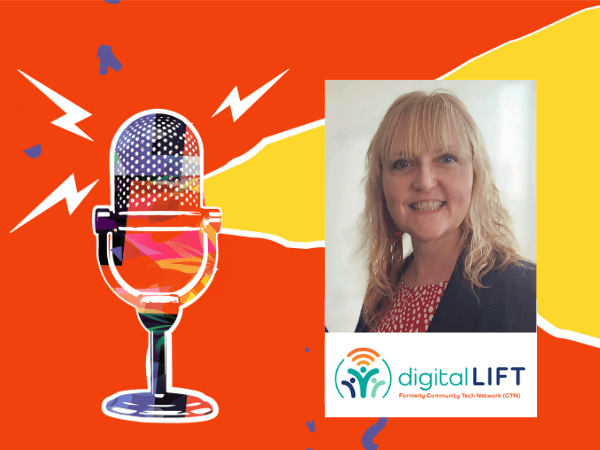
In 2008, when Kami Griffiths and a small group of colleagues transformed a winding-down TechSoup initiative into an independent nonprofit, they weren’t chasing a business opportunity — they were responding to a glaring need. Seventeen years later, that response has evolved into digitalLIFT, a nationally recognized organization breaking down one of the 21st century’s most persistent barriers: the digital divide.
“We help people harness and benefit from the power of technology,” Kami says. “That means working with housing developments, senior centers, and other social service agencies to bring their clients across to the other side of the digital divide.”
Kami’s journey to founding digitalLIFT wasn’t linear — or planned. With a background in graphic design, she felt unfulfilled creatively and sought purpose through volunteering. Whether tutoring youth in Photoshop or supporting adult literacy, she found joy in helping others learn. That joy became a calling.
In New York City, Kami began volunteering with the Parks Department, which operated 27 public computer centers across the five boroughs. She was soon hired as a computer instructor and spent nearly four years teaching more than 300 adults, many of whom were navigating technology for the first time.
That mission led her back to the Bay Area, where she joined TechSoup and, ultimately, launched digitalLIFT (originally Community Tech Network) when the program was no longer a fit for the parent organization.
As founding executive director, Kami worked unpaid in digitalLIFT’s first year, a familiar story in grassroots nonprofit work. Over time, as funding grew, so did the organization — from a scrappy local effort in San Francisco to a nationwide resource now supporting thousands of learners each year.
The “digital divide” isn’t just about whether someone owns a device, it’s about whether that device is suitable, whether they have consistent internet access, and whether they possess the skills to use it meaningfully.
“Most of the people we work with, over 80%, are older adults,” Kami says. “They often missed out on learning technology when it first emerged, or they learned it in the workplace decades ago. Now everything looks different, especially with touch screens.”
That’s where digitalLIFT steps in. Through in-person classes, online instruction, one-on-one tutoring, and “training the trainers,” they equip learners not just with skills, but with confidence. The organization’s 20 full-time staff and 14 part-time trainers (many of them bilingual or trilingual) support diverse communities, which is a necessity when over half of digitalLIFT’s learners do not speak English. Their multilingual curriculum, now offered in at least 10 languages, is a cornerstone of the model.
“Training should happen in someone’s own language,” Kami says. “Translation slows things down. It’s harder for people, especially older adults, to follow.”
Growth hasn’t come without challenges. One of the biggest: fundraising. Despite digital literacy being a foundational issue — affecting everything from telehealth and employment to education and social connection — it’s rarely a direct funding priority.
“We often have to position our work as the solution to another problem [...] social isolation, for instance,” Kami says. “Funders aren’t always excited about technology. They don’t always get what we do or where we fit.”
In 2022, the State of California announced a $48 million digital inclusion initiative focused on older adults and people with disabilities — a natural fit for digitalLIFT. Their budget doubled within a year, from $1.5 million to over $3 million, bringing rapid growth and new logistical hurdles.
“When your budget doubles that quickly, things break,” Kami says. “You need more staff, more managers, better systems. It was a learning curve.”
Still, the organization’s impact is undeniable: more than 3,000 learners are supported each year, hundreds of nonprofits and trainers empowered, and a growing library of resources including webinars, an e-book, and a suite of online courses.
What sets digitalLIFT apart isn’t just its multilingual reach or its digital curriculum — it’s the underlying philosophy: build capacity within communities. By training social service staff and volunteers to deliver tech education themselves, digitalLIFT is slowly decentralizing the work.
“We want to work ourselves out of a job,” Kami says. “Social service agencies should be integrating digital skills training into their own programming. Our goal is to make that easier for them.”
That’s why their online resources — developed from nearly two decades of real-world experience — are available nationwide. Some are free; others come with a small fee. All are rooted in the belief that no one should be left behind because they don’t know how to download a PDF or join a Zoom call.
For now, digitalLIFT is operating in an uncertain funding environment. The Digital Equity Act, passed in 2021 and set to release $2.75 billion for exactly this kind of work, is currently on hold. But, Kami remains hopeful and determined.
“We built our business expecting that money to be flowing by now,” Kami says. “It’s disappointing, but the need hasn’t gone away.”
In fact, it’s evolving. As artificial intelligence begins reshaping the digital landscape, Kami sees a new frontier, and new urgency.
“We have to roll with the technological changes in a way that serves the wider community,” she says. “And we need more decision-makers at social service agencies to recognize that digital access isn’t optional anymore.”
Kami’s leadership is a testament to what’s possible when purpose, perseverance, and a little bit of tech savvy come together. From unpaid founder to nationally recognized expert in digital inclusion, she’s built something extraordinary — not for personal gain, but to help others stay connected in this new digital world.